
Pointe Shoe Info + Know-How
A quick guide to understanding the parts of a pointe shoe — helpful whether you’re shopping for your first pair or your fiftieth.
Pricing Overview
Affordable, professional pointe shoe fittings and accessories for dancers of all levels.
First-time Consultation Fitting
£40.00
Pointe Shoes
from £75.00 to £125.00
Accessories
Toe pads
£20.00
Tights
from £7.50
Ribbon sewing
£20.00
Suede tips
£3.50
Ribbons and Elastics
no charge
Pointe Shoe History
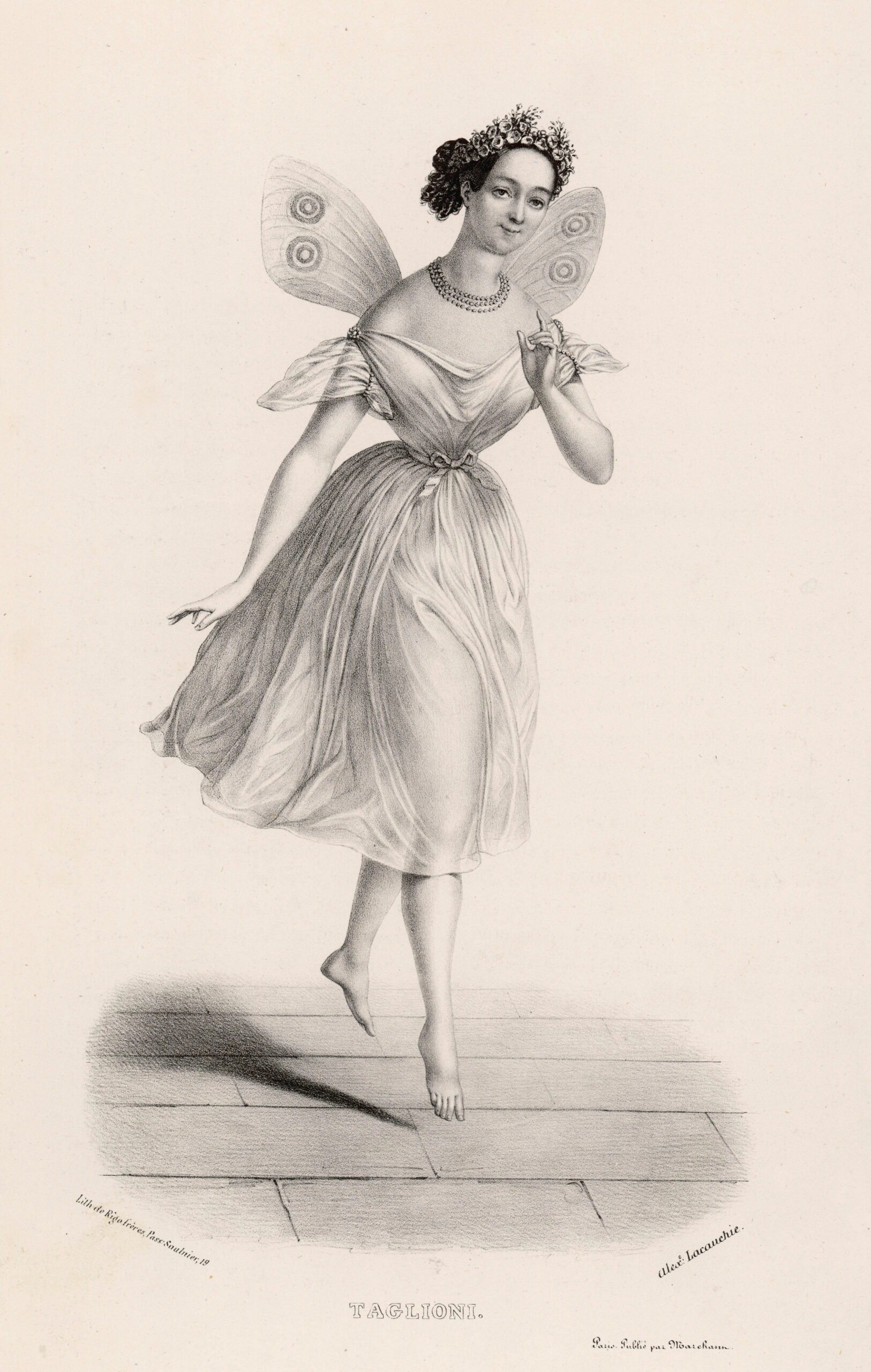
When ballet dancers first explored the possibility of dancing on the tips of their toes in the satin, heel less slippers which were then fashionable in the 1820s and 1830s, they wanted to project the illusion of weightlessness which, of course, they were already demonstrating with their jumps. At the time in well-equipped theatres, weightlessness was often achieved using harnesses, usually positioned underneath the wings in the dancer’s costume. It’s difficult to imagine how liberating it must have been for dancers such as Marie Taglioni to have broken free of her reliance on ropes and pulleys and to be able to perfect a sylph-like impression just with her own technique and stiffened shoes.
The pointe shoe has evolved over the past 200 years, with the help of famous shoemakers such as Freed, Porselli, Bloch, Capezio, Gaynor Minden etc, to be able to sustain ever more technical, balance and pas de deux requirements.
Pointe shoemakers use several terms to describe their shoes. You might find it helpful to understand what these terms mean when you’re comparing different models with a view to buying.
Pointe Shoe Glossary
Tap each term to learn more
Box
also called the block, is the part of the shoe that holds your toes and the metatarsal area of your foot in place. The stiffness typically comes from layers of paste – the more paste, the stiffer the box. Boxes can also be made fully or partially from other materials such as plastic-based substances. Graduated boxes provide more hardness and support towards the tip of the shoe, and less around the metatarsals. Boxes can be tapered (with more width around the toes and less towards the tip) or square (with more uniform width from top to bottom). It is very important that this part of the shoe is fitted as snugly as possible and, ideally, echoes the shape of your forefoot. It should feel almost like a corset for the lower part of your foot not least because it works in partnership with the shank (see below) to provide support and, in effect, to defy gravity.
Shank
is the part of the shoe that provides support to the arches and is like a spine sandwiched between the outer leather sole and the inner sole. Traditionally, shanks have been made of redboard (a type of stiff cardboard/fibreboard). Some makers use use other materials that may be less susceptible to breaking or may hold their shape better but can be more springy and make it difficult to roll up and down from flat onto pointe via demi-pointe. Pre-arched shanks and shortened shanks (such as three-quarters) can help reduce strain on high arches, and can help beginners and those with low arches to get up onto pointe. Graduated and skived shanks decrease in hardness/shank towards the heel. Most shanks will need breaking in just behind the heel and at the demi-pointe area although this depends on the pliability of the shank.
Last
is like a mould that determines a shoe’s general shape. Most models are made on individual lasts, although some makers may use the same last for several models, with differences in the other features. Each different length and width will have a different last
Platform
of the shoe is the tip of the box, the surface you dance on. The larger/wider the platform, the more likely you will be able to remain stable especially if you are balancing on one foot. If you have high arches and weak ankles, a larger platform can be helpful to stablise your position on pointe. The smaller the platform, the faster you will be able to turn in pirouettes and fouettes.
Profile
of the shoe is the height of the box from the sole to the top of the foot. Dancers should choose a profile that fits their toes, as a too-low profile will squash a thick foot and a too-high profile will fail to support a less full foot.
Vamp
of a shoe refers to the length between the platform and the instep of the foot. Higher vamps are more supportive and cover more of the foot. V-vamps offer the benefits of a high vamp with less fabric over the middle of the toes. If you have shorter toes, you might prefer a lower vamp so that your metatarsal is less constricted particularly when rolling up and down through demi-pointe.
Wings
extend the stiff part of the box on the sides and sometimes behind shoes for extra support.
Got a question?
I’m always happy to help — just drop me a message.